School of Architecture, Tsinghua University
Cities, urban design, urban planning
In Triumph of the City, the renowned economist Edward Glaeser wrote that cities are humanity’s greatest invention and its finest hope. He even urged people who love nature to leave Walden Pond behind and settle in crowded central Boston: living in concrete buildings can be more environmentally friendly than living in a forest. By a striking coincidence, shortly before the book was published, The Boston Globe reported that the many admirers of Thoreau had overcrowded Walden Pond, putting its natural environment and landscape at risk.
Dong Qing also said in the second season of The Reader: “Cities are humanity’s greatest invention, accommodating every path a life may take. In a city, behind every street and every building lies a world of its own. For Hemingway, the city was Paris, the moveable feast he saw before him; for Lao She, the sky over Beiping was something he could never leave behind; Shanghai, meanwhile, gave Eileen Chang her most magnificent melancholy.”
The subject of cities
As a researcher working on cities, I approach this subject more critically and do not share the idealized outlook of economists or literary and artistic figures. Yet there is no denying that cities carry modern civilization, that they are a remarkable form of human existence, and that they matter closely to the overwhelming majority of us.
Given the importance of cities, I would like to use the PhDSciNet platform today to share some ideas about them, specifically the difference between urban design and urban planning. If you are outside this field, you probably hear the terms “urban planning” and “architectural design” most often; “urban design” may be less familiar.
In fact, since the Central Urban Work Conference in December 2015, growing enthusiasm for the “urban double repair” initiative—ecological restoration and urban repair—has gradually made urban design a prominent field in China. Research using Google Scholar suggests that international interest in urban design peaked from the 1970s through the 1990s, while attention in China began rising in the mid-1990s and has since become a nationwide focus. Statistics from CNKI likewise show that the number of papers related to urban design exceeded one thousand by 2017.
At the national level, responsibility for urban planning and urban design originally lay with the Ministry of Housing and Urban-Rural Development. On March 13 of this year (2018), however, the urban and rural planning responsibilities formerly held by that ministry were transferred to the newly established Ministry of Natural Resources. Against this complicated background, and faced with such an important subject, I do not want to act as a preacher. Instead, I hope to plant a seed of urban design in the minds of friends from other disciplines and explore further possibilities together.
Urban design
Let us first look at how Wikipedia explains urban design:
Urban design is the process of designing and shaping the physical features of cities, towns and villages. In contrast to architecture, which focuses on the design of individual buildings, urban design deals with the larger scale of groups ofbuildings, streets and public spaces, whole neighborhoods and districts, and entire cities, with the goal of making urban areas functional, attractive, and sustainable.[1]
This explanation shows that, although urban design has existed for several decades, it remains a very young discipline compared with architectural design, which has a history spanning centuries. In Europe and North America, cities have grown in size, producing enormous urban areas unlike any seen previously. Urban planning, which originally concerned only physical spatial planning, has had to incorporate more abstract subjects such as socioeconomic planning and big data, while the share devoted to planning and design has diminished. Planners allocate resources through two-dimensional land use, while architects focus on spaces within a site and its immediate surroundings. How, then, can we improve the quality of spatial use across an entire city? This is where the value of urban design (Figure 1) becomes apparent.
In response to this situation, Eliel Saarinen, working in the United States, first proposed the concept of “urban design” in the early twentieth century. At the first international academic conference on urban design, held at Harvard University in the United States in 1956, scholars reached a consensus on its spatial role: urban design is the “bridge” that fills the “gap” between urban planning, architecture, and landscape architecture. This spatial role was clearly defined.[2]
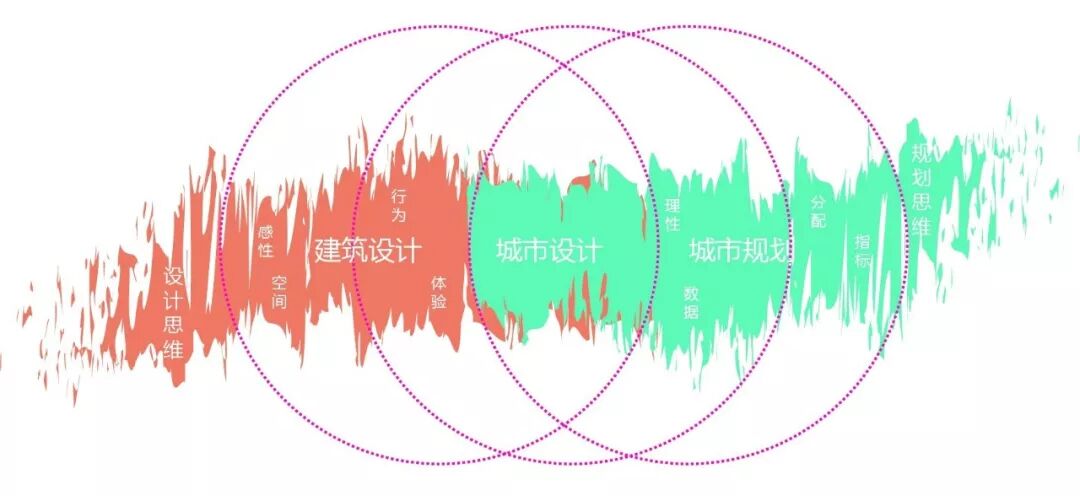
Scholars nevertheless disagree about how to build this “bridge” of urban design. In the United States, for example, Kevin Lynch, who had an architectural background, advocated extending it from architecture; Michael Southworth believed it should grow out of urban planning. Jonathan Barnett, with a planning background, maintained that “urban design is the process of setting directions for the design of a city’s physical spaces,” and that between urban planning and architecture there must be an urban designer able to “design the city without designing the buildings” from a three-dimensional perspective.[2] In China, although ideas of urban design have existed since ancient times, many academic debates remain. Today, we should carry this spirit forward, integrating urban design as a way of thinking throughout the urban planning process. As a disciplinary field, however, it should have its own boundaries, research objects, and space in which to exist; as a professional skill and technique, it requires specialized training for urban designers.[3]
As Professor Zhu Wenyi of Tsinghua University has said, whether a city or its built-up areas are pleasant and of high quality depends not only on the quality of buildings and planning, but also on the quality of the urban spaces created through planning and architecture. Today on PhDSciNet, I have introduced urban design: a discipline at once old and young, and closely connected with shaping the quality of urban space. If you would like to explore this subject further, I recommend Tsinghua University’s journal Urban Design. Published on the twentieth day of every second month, it is also China’s first journal devoted to urban design.
*This article expresses the author’s personal views and does not represent those of this website. Other media, websites, or individuals reproducing material from this website must identify the source and assume responsibility for copyright and other legal matters. Authors who do not wish their work to be reproduced, or who wish to discuss reproduction fees or related matters, should contact us.
About the author

Hello, everyone! I am Bian Yizhi from the PhDSciNet team:
Affiliation: School of Architecture, Tsinghua University;
Research area: urban design;
My thoughts on science communication: before beginning my PhD, I spent several years studying and traveling in Brussels and Leuven in Belgium, and Munich and Leipzig in Germany. I have worked or interned at both large state-owned design organizations and small avant-garde practices. I was once passionate about architectural design, but later realized that a good living environment requires not only excellent buildings, but also well-shaped urban spaces. I therefore moved toward the design and study of urban space at a larger scale, with research focusing on disadvantaged urban spaces. I believe science communication is especially important in this age of information overload. Although people now have more ways to access information, its quality varies enormously. Information that lacks even basic common sense can often circulate widely. PhDSciNet offers an opportunity to set the record straight, allowing more people to look beyond confusing appearances and reach the substance of things.
References
[1] Boeing; et al. “LEED-ND and Livability Revisited”. Berkeley Planning Journal., 2014(27): 31–55.Retrieved 2015-04-15.
[2] Jin Guangjun. “Regulatory Detailed Planning and Urban Design.” Journal of Human Settlements in West China, 2017(4): 1–6.
[3] Jin Guangjun. “Illustrated Discussion: How to Build an ‘Urban Design Bridge’ with Chinese Characteristics.” Urban Design, 2016(2): 14–29.
Sources and editorial history
Restored from a complete historical article exported from the PhDSciNet Official Account.