
PhDSciNet elements team
Did you know: the English name zirconium comes from zircon, a natural gemstone that can rival diamond1.
What Kind of Element Is Zirconium?
PhDSciNet answers: Zirconium—pronounced gào in Chinese—is element 40 in the periodic table. Its nucleus contains 40 protons, and it is a transition metal. Its oxidation states include +2, +3, and +4. Stable zirconium isotopes include zirconium-90, zirconium-91, zirconium-92, and zirconium-94, and its relative molecular mass is 91.22.
How Was Zirconium Discovered?
PhDSciNet answers: Sparkling zircon has been used as a gemstone since ancient times, but zirconium was discovered relatively late. In 1789, the German M. H. Klaproth managed to dissolve zircon and analyze its composition. He ruled out calcium, magnesium, and aluminum, but found a mysterious precipitate. The element hidden within it was named zirconium. Metallic zirconium was first prepared by the Swedish scientist J. J. Berzelius in 18241.
What Are the Properties of Elemental Zirconium?
PhDSciNet answers: Zirconium is a light-gray metal with a density of 6.49 g/cm3. Like other metals, zirconium has a metallic luster, and a layer of oxide film readily forms on its surface. Metallic zirconium has high-temperature resistance, and corrosion resistance. Its melting point is 1852 °C and its boiling point is 4377 °C. Apart from dissolving in hydrofluoric acid and aqua regia, it is highly resistant to corrosion by other acids, bases, and salts. Yet zirconium also has a restless side as a metal: zirconium powder and wire can burn at 200 °C, emitting a dazzling light1.
Figure 1: Metallic zirconium2
Metallic zirconium has another special ability: a strong affinity for hydrogen, nitrogen, and oxygen. When heated, it can absorb large amounts of these gases. Industry uses this property by coating vacuum components with zirconium powder to absorb residual gases, improve the vacuum, and protect the components.
How Is Metallic Zirconium Produced?
PhDSciNet answers: Natural zirconium ores, such as zircon, react with carbon at high temperatures to form zirconium carbide. This is then chlorinated to produce zirconium chloride, which is finally reduced to metallic zirconium by reaction with magnesium. Zirconium chloride can also be converted to metallic zirconium by molten-salt electrolysis.
The Main Uses of Zirconium Alloys
Zirconium has distinctive properties. In steelmaking, adding just one part per thousand of zirconium produces a remarkable improvement in hardness and strength. Zirconium-containing armor steel, forged cannon steel, stainless steel, and heat-resistant steel are important materials for weapons such as armored vehicles, tanks, cannons, and bulletproof plates.
Zirconium alloys have advantages in nuclear reactors that other alloys cannot match: zirconium atoms have a very small collision cross section for thermal neutrons and do not readily absorb neutrons, while also offering good compatibility with nuclear fuel. Zirconium alloys have good corrosion resistance and moderate mechanical properties in high-temperature, high-pressure water and steam at 300–400 °C. They can therefore serve as structural materials for the cores of water-cooled nuclear reactors1.
Tough Zirconium Dioxide
Zirconium dioxide is one of zirconium’s most important compounds. It is a high-grade refractory material. Adding white zirconium dioxide to ceramics gives them new vitality, making them whiter, brighter, more heat-resistant, and stronger. High-temperature ceramic insulators made from these ceramics have high insulating capability and a low expansion coefficient, and are essential components of high-voltage transmission lines3.
A Natural Gemstone: Zircon
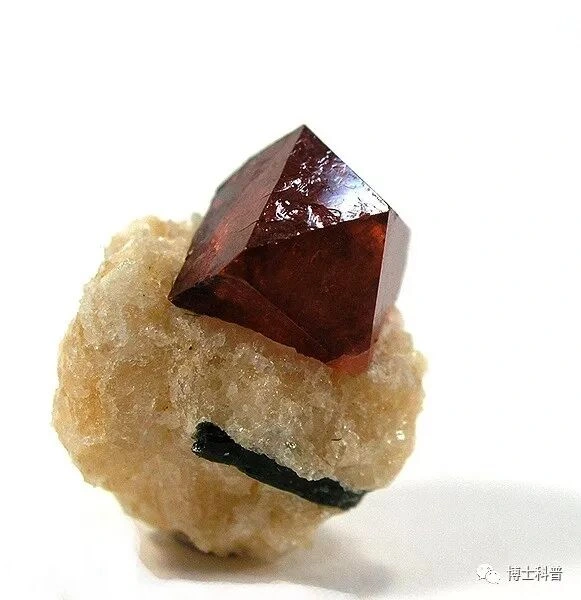
Zircon, a crystalline zirconium silicate, can rival diamond. Among natural gemstones, its refractive index is second only to diamond, and it has very high dispersion. Carefully cut and polished by a jeweler, it produces a brilliant sparkle. Besides colorless, transparent forms, some natural zircons occur in reddish-brown, green, blue, and other colors.
Figure 2: Red zircon4
Health and Environmental Hazards
No cases of industrial zirconium poisoning have yet been reported1. However, natural ores may contain radioactive impurities5, so gemstones of unknown origin should not be worn against the body.
Fine powders are highly combustible and can sometimes ignite spontaneously and explode. Zirconium powder can also burn in carbon dioxide and nitrogen. Heating, exposure to flames, or contact with oxidizers can cause the powder to burn and explode.
*This article represents the authors’ personal views and does not represent the views of this website. Other media, websites, or individuals reusing or republishing it must acknowledge the source and assume responsibility for copyright and other legal matters. Authors who do not wish to have their work republished, or who wish to discuss remuneration or other republication matters, should contact us.
References
1 Baidu Baike: Zirconium
2 Wikipedia, Zirconium
3Editorial group of The Story of Chemical Elements. The Story of Chemical Elements (Youth Science Museum series). China Publishing Group, World Book Publishing Company. Kindle Edition
4 Wikipedia, Zircon
5 Baidu Baike: Zircon
Illustrations from the matching WeChat article
The following illustrations were recovered from the matching article retained in the WeChat account and restored in their original order.
Sources and editorial history
Additional illustrations were recovered from the matching article retained in the WeChat account and collected after the main text; the archived text and existing editorial corrections are retained.


